


In 2020, Magué’s commitment to social justice led her to the Matamoros refugee camp, where she turned her creative practice into powerful activism. There, she documented the harrowing stories of mothers at the border, immortalizing their courage through evocative sketches and intimate interviews that humanize the migrant experience.
With a grant from the San Francisco Art Commission and an alliance with Nuevo Sol SF, these portraits, created from actual workers I have come to know, stand as both a monument and a meditation—an homage to the people whose work sustains us, often without recognition or permanence. This sweeping narrative brings to the forefront the lives of migrants whose labor has nourished generations, helped drive business creation, fueled innovation, filled essential workforce needs, and strengthened the middle class. Our nation’s success comes, in large part, from our longstanding tradition of people seeking a better life, leaving everything they know to contribute to the United States, yet they work without sick care or retirement.
10 (5 here)-40” x 48” x 1.75” | acrylic, collage, wax crayon, oil, and wax on wood panel


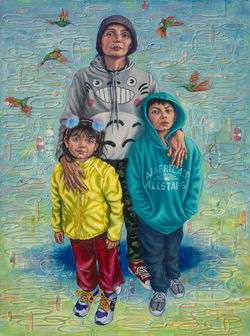
LAS MADRES These figurative paintings with Madres (mothers) in heroic postures are homages to the working mother. Mothers are the invisible labor, unpaid, underpaid, undervalued, unappreciated, and overlooked for their contributions to multitasking duties in this complex fabric of our society. They have been, and still are a large part of institutionalized gender inequality. This invisible economic engine where women do the cooking, cleaning, child, and elder care keeps them from advancing economically, at work, and in society. For me, it is important to represent women in a strong manner and to illustrate the dignity I witness in them and hope to give voice to their oppression. Their attitudes provide intimacy, strength, endurance, pride, and unsparing honesty in wanting and praying for nothing less than a better future for their children.
 |
|---|
The family in the above painting was from Venezuela seeking political asylum in a refugee camp of over 2000 people in Matamoros, Mexico. Isabel C. Olarte and family left everything behind to provide a better future for her two children. They had been waiting seven months under dire conditions to be granted immigration status in the US. Isabel was one of the few women I interviewed. I met them in February 2020, before the pandemic.
This work was featured in
The de Young Open 2023
and this year it is featured at the Triton Museum
 |
|---|
This work was featured in
The de Young Open 2020!
 |  |
|---|---|
 |